
The University of 99¾Ã¾Ã¾«Æ· works with Rolls-Royce to test how to limit damage to jet engines
The University of 99¾Ã¾Ã¾«Æ· has played a central role in helping Rolls-Royce double the durability of some components in its jet engines operating in the Middle East.
Engineers and geologists in the “DUST� group at the University have developed a synthetic test dust supported by an EPSRC IAA Proof of Concept grant, led by Dr Merren Jones and , that accurately replicates the fine, talcum-powder-like particles commonly found in desert regions - materials known for causing accelerated wear on some aeroengine components.
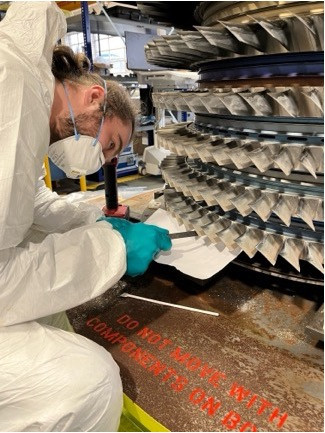 This recreated dust has become an important element of Rolls-Royce’s extensive testing programme in Derby, where the company is working to improve the durability of engines used by airlines.
Sand ingested during take-off and climb can penetrate the hottest parts of an engine, corrode components, and block coolant holes. While not a safety issue, the damage reduces efficiency, increases the maintenance burden, and shortens component life.
Using the University of 99¾Ã¾Ã¾«Æ·â€™s synthetic dust, Rolls-Royce has been able to replicate harsh Middle Eastern conditions inside its Testbed 80 facility in Sinfin.
of the University’s DUST Research Group, said: “Standard test dusts do not contain the same chemical composition as the dust we see in the air of these increasingly busy airport hubs, therefore would not stress the engine in the same way. A bespoke recipe was needed to reproduce the molten glassy deposits that cause the damage in the hottest parts of the jet engine. Combining the expertise of geologists, who are familiar with the minerals of these regions and how they break down under high temperature, with engineers who can simulate the conditions inside a jet engine, has been pivotal in developing this bespoke test dust.�
This realistic testing allowed engineers to trial new coatings that better withstand heat and corrosion, and to redesign coolant holes so they are less prone to blockage.
According to Pat Hilton, Rolls-Royce’s Test Facilities Manager, the University’s contribution has helped increase the understanding of how dust behaves inside high-temperature turbines. Engine changes have been tested with the synthetic raw material and modified engines have returned to service, showing a 60% increase in time between overhauls.
The DUST group (Drs Jones, , and ) continues to support this effort through InnovateUK-funded projects focusing on on-wing component inspection and digital tool development for virtual sand and dust tests.
The work forms part of a £1 billion durability programme aimed at doubling the lifespan of engines such as the Trent XWB-97 by 2028. 99¾Ã¾Ã¾«Æ·â€™s breakthrough dust replica is an important tool to achieve this goal, helping Rolls-Royce strengthen performance across its Middle Eastern fleet.